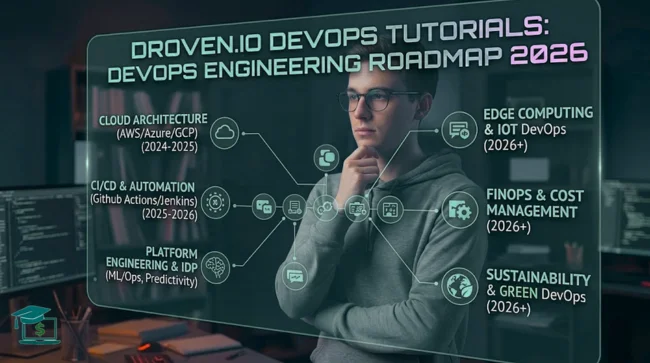
Droven.io DevOps Tutorials: DevOps Engineering Roadmap 2026
Learn DevOps Engineering and the DevOps Roadmap to 2026 with Droven.io DevOps Tutorials. A DevOps journey is fraught with choices for hiring.Imagine choosing a career path when you’re on a DevOps journey, with lots of options for hiring.
The technology job landscape has changed significantly. Businesses are not only looking for developers that can write code; they’re searching for engineers able to build, deploy, automate, and monitor entire systems on a massive scale. That’s where DevOps engineering comes in.
“An adaptive roadmap that adjusts learning steps based on your progress and objectives.”
If you’ve been following the droven.io DevOps tutorials, you will know that learning DevOps in 2026 is not just a career change, it’s a mindset shift towards software, automation, and business technology.
In this article, you will learn a realistic and easy-to-understand DevOps engineering roadmap for 2026. Whether you’re a new beginning wanting to get your bearings or an IT pro ready to up the ante, this guide provides actionable steps, tangible tools, and honest recommendations on the ways to monetize DevOps skills — from employment, freelancing, certifications and beyond.
Unfortunately, there is no definitive answer as to what DevOps is exactly, much less why it matters in 2026.
What Is DevOps and Why Does It Matter in 2026
DevOps is the melding of development and operations (DevOps) practices that enable teams to produce software quicker and more reliably. It helps you transition from coding to production.
From startups to Fortune 500 businesses, everyone is investing in DevOps in 2026 as it helps in reducing deployment failures, quick product releases, and lowers infrastructure expenses.
It translates to high demand and good pay for professionals. Current labor market statistics suggest that DevOps engineers make some of the highest salaries in the USA and worldwide, ranging from $95,000 to $160,000 per year, and even more for senior engineers and consultants.
Often, Droven.io enterprise tech innovation content draws attention to the change in IT industry roles from legacy IT operations to cloud-native DevOps roles and the acceleration of this change.
The Droven.io DevOps Tutorials Engineering Roadmap for 2026
Stage 1 — Build a Solid Foundation
There are basic tools that must be mastered before working with advanced tools.
This includes:
- Linux basics (File systems, permissions, shell scripting)
- Basic network concepts (DNS, HTTP, TCP/IP, Firewalls)
- Introduction to version control with Git and GitHub.
- Basic programming or scripting skills in Python or Bash.
These skills are essential! All DevOps tools you use subsequently will rely on them. Use free resources such as the Linux Foundation courses, the GitHub learning labs, and the Python documentation.
Stage 2 — Learn Cloud Platforms
Cloud is the foundation of today’s DevOps. The three main platforms are Amazon Web Services (AWS), Microsoft Azure, and Google Cloud Platform (GCP) in 2026.
Pick one to start. AWS continues to be the most popular choice for enterprise use. Azure is the preferred platform for corporate and organizations where Microsoft is predominant. Data and AI related teams continue to expand quickly at GCP.
Focus on learning:
The virtual machine and compute services are the same.Virtual machines and compute services are identical.
- Storage solutions
- Identity and access management.
- Serverless functions
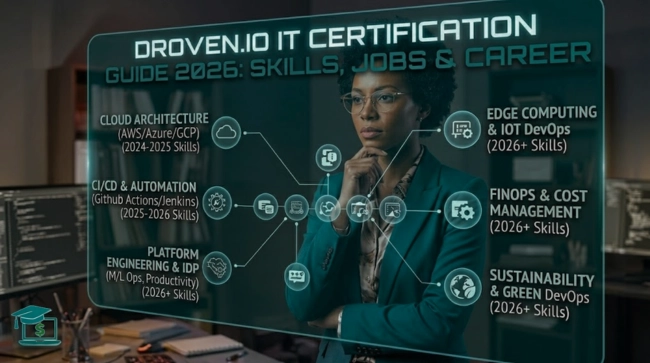
The content of the Droven.io IT certification guide suggests that you begin with your first certification, AWS Cloud Practitioner and then progress to the AWS Solutions Architect Associate exam. These credentials are marketable and can give you the edge in your job search.
Stage 3 — Master CI/CD Pipelines
DevOps is all about Continuous Integration and Continuous Deployment (CI/CD). The process of automatic test, build and deploy code.
Tools to learn:
- Jenkins (Popular in enterprise settings)
- GitHub Actions (Easy to get started, well integrated with GitHub)
- The other options are:
- ArgoCD and CircleCI for Kubernetes deployments
Construct a working pipeline. At least create a GitHub repository, add automated tests and use GitHub Actions to automatically deploy your application even for personal projects. There is more to learning than theory.
Stage 4 — Containers and Orchestration
Docker and Kubernetes are among the top skills in the tech market updates for the USA in this week’s Docker report. Without these steps, you miss out on the heart and soul of modern DevOps.
Docker allows you to bundle up your application and all its requirements into a package, which you can then run consistently anywhere. Kubernetes automates the deployment, scaling and self-healing of those containers at scale.
Learn Docker first. Create and execute containers on local machine. If this is the case, then migrate to a managed service like Amazon EKS or Google GKE. The Certified Kubernetes Administrator (CKA) exam is among the most esteemed certifications in the field.
Stage 5 — Infrastructure as Code
Infrastructure as Code (IaC) is a concept that involves managing infrastructure—such as cloud resources, networks, and servers—by using code, not by configuring them manually.
Key tools:
- Terraform (the industry standard for multi-cloud IaC)
- These differ from one another.These are not the same.
- Molecular Meta (if you are working in a molecular environment)
By learning just Terraform, you can get to senior-level positions and lucrative freelance jobs. There’s a high demand for people who can build and operate cloud systems using code.
Stage 6 — Monitoring, Observability, and Security
A full fledged DevOps Engineer knows how to be vigilant and find out what has gone wrong in a system in no time at all. Learn tools like:
- Prometheus and Grafana for metrics and dashboards.
- ELK Stack (Elasticsearch, Logstash, Kibana) for log management
- You can use Datadog or New Relic, which are enterprise monitoring tools.
From the security perspective, DevSecOps is now a must-have skill. This will cover vulnerability scanning, secrets management using HashiCorp Vault and embedding security checks into your CI/CD pipeline.
Freelancing and Income Opportunities in DevOps
A devops freelancer/coder needs to understand freelancing and income opportunities. Freelancing and Income Opportunities in Devops. DevOps is not only a career trajectory, it’s a solid freelance career option as well. There are various platforms that constantly post DevOps contracts that vary from one-time migrations to continuous support for infrastructure.There are many sites that post DevOps contracts on a regular basis, including short-term migrations to infrastructure support jobs that last for years.
Common freelance DevOps services include:
- Cloud infrastructure configuration and moving to the cloud – How to configure the cloud infrastructure and migrate to it
- CI/CD pipeline implementation
- The configuration of Docker and Kubernetes.- DockerK8sConfig: Docker and Kubernetes configuration.
- Security audit and compliance automation
Driven by the advantages of AI automation, the use of DevOps skills is emerging as a complementary field for professionals to provide more value in their services to clients, as seen in Drovenio AI tools 2026 coverage. The more you can automate infrastructure management with AI-powered tools such as GitHub Copilot or AWS CodeWhisperer the more you can make.
Create a LinkedIn profile with keywords, a portfolio on GitHub with actual projects and a very basic blog or portfolio site. With time and effort, these three can create inbound freelance inquiries in a couple of months.
AI Tools that will shape DevOps in 2026
Drovenio AI for business and DevOps are becoming more and more intertwined. AI is now increasingly integrated into the DevOps workflow, in a down-to-earth way:
- AI Code Suggestions shorten development time.
- Automated Anomaly detection – proactively detect system failure
- Predictive scaling dynamically allocates the resources of a cloud according to the patterns of cloud consumption.
- Natural language interfaces enable teams to ask questions about log and metrics using natural language.
There are already tools such as AWS DevOps Guru, Google Cloud’s AI operations suite, Microsoft Copilot for Azure and more in production. Once you become familiar with how to use these tools, you’ll be a better contender for senior positions.
At every stage of the droven.io AI career roadmap, the engineers with a combination of traditional DevOps skills and AI tooling knowledge are getting offers quicker and are being able to negotiate higher salaries.
Pro Tips for Droven.io DevOps Success
- Build in public: Create a GitHub and LinkedIn Learning Journal. Employers aren’t alone in reading your activity, they read your resume, too.
- Specialize early: Don’t be “good enough” with every cloud platform and orchestration tool: be “Great enough” at one cloud platform and one orchestration tool. In the job market, quality trumps quantity.
- Make contributions to open source: Any positive activity on popular DevOps tools and solutions creates trust and industry relationships.
- Keep up to date without becoming overexcited: Instead of learning all new tools they emerge, stick with some trusted newsletters, such as DevOps Weekly or The DevOps Handbook community.
- Make purposeful certification: Select the certifications that are relevant to the employers you’re interested in. Before investing time and money, look into job postings in your area.
Common Mistakes Beginners Make – Droven.io DevOps Tutorials
- Ignoring the basics — Many people get into Kubernetes without being familiar with either Linux or networking. That means confusion and can take months of work. First is to build the base.
- Without building projects, there are no opportunities for collecting certifications — Certifications open doors but real projects close them. Do not forget to construct a real object in addition to studying it.
- Learning not limited to learning tools — DevOps is about workflows and integration. Understand the interdependence of tools, rather than their individual operation.
- If any engineers fail to pay attention to soft skills, they get to work closely with development teams and operations, as well as with business stakeholders. Your career is influenced by your communication skills.Communication skills are a direct influence on your career.
- Charging beginner rates for freelance services — Many new DevOps freelance work good at work at beginner pricing even when they have acquired genuine abilities. Research the market for rates and set your rates as per the research.
FAQ Section – Droven.io DevOps Tutorials
What should be the first step for a DevOps beginner for 2026?
Begin with Linux fundamentals, Git and a scripting language, such as Python or Bash. Then it’s time to learn the basics of cloud on AWS. This sequence provides you the best starting point before getting into Docker or Kubernetes.
How long will it take to get ready for work in DevOps?
Most people, with consistent daily study and hands-on practice, are able to attain entry-level job-ready status in 8-14 months. This is assuming that you’re spending 1-2 hours everyday learning and construction projects.
What are the best Certifications for DevOps Engineers?
In 2026, the most well-known certifications that hiring managers seek are AWS Solutions Architect Associate, Certified Kubernetes Administrator (CKA), and HashiCorp Terraform Associate.
Is it possible to implement DevOps as a freelancer?
Yes, and, it’s a good freelancing road to choose. Services such as cloud migration, pipeline setups and automation of infrastructure are used for business outsourcing. It’s not only full-time jobs that can provide a well-paying job in DevOps.
What is the impact of AI on DevOps?
AI is taking over repetitive jobs such as anomaly detection and deployment risk analysis, as well as resource scaling. This doesn’t go so far as to remove DevOps jobs, but it moves them to a more advanced level of design, architecture and AI tools management. The more that engineers learn to use such tools, the more valuable they are.
Conclusion: Don’t take the Roadmap lightly
The field of DevOps engineering in 2026 offers a career path that is both deeply rewarding and in high demand, with several avenues for earning income such as full-time roles, freelance and consulting opportunities. Today, with the array of tutorials and resources available for DevOps, it is easier than ever to go through a well-defined learning curve.
There is no doubt about the one thing you will do: develop your Linux and scripting skills, learn one cloud platform, acquire CI/CD and Containers skills, and develop Infrastructure as Code skills. Gain AI tooling knowledge, obtain the proper certifications and establish a recognizable portfolio.
It is more important to be consistent than fast. Emphasize practical skills, don’t skip steps, and be honest about your learning level. Droven.io DevOps Tutorials is a craft, and only the professionals who think of it as a craft are successful in it.
Begin at your starting point. Use what you have. Create a tangible product today.