
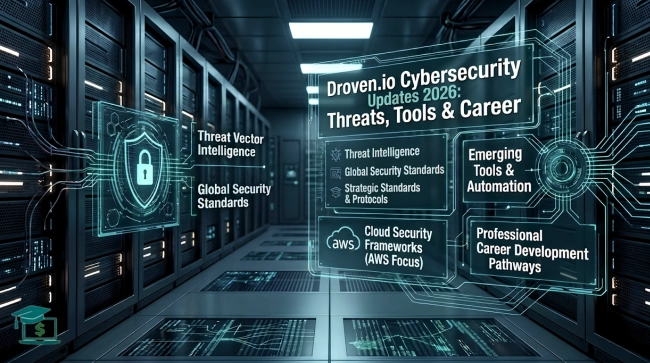
Introducing Droven.io Cybersecurity Updates 2026: Threats, Tools & Career Guide.
Another company gets the attention it doesn’t deserve each week, as the result of a data breach or ransomware attack or stolen identity. Cybersecurity is not just a technical specialty or for government departments or the largest Fortune 500 companies. It has grown to be the backbone of each web based enterprise.
You’ve likely been reading about the dramatic shift in the Droven.io Cybersecurity Updates landscape of 2026 – if you have been, you’ll know. Threats are more intelligent, tools are more effective, and the potential for a career in this area is greater than ever. If you are looking to safeguard businesses, find a good-paying telecommuting position or start earning income through cyber skills, you have a concrete one to get started with Droven.io Cybersecurity Updates.
It explains the most pressing threats of 2026, the tools that professionals are utilizing at the moment and how you can leverage your cybersecurity expertise to make a secure career that grows over time.
The biggest cybersecurity dangers for 2026
The first step to developing the expertise that employers and clients will pay for is understanding threats.
AI-Powered Phishing Attacks
Now, attackers are leveraging artificial intelligence to design phishing emails that appear and sound legit from your bank, employer or government. These aren’t the “clumsy” scam emails of the past! They are personalized and grammatically correct and can be quite hard to identify if you don’t know what to look for or have the proper tools.
Ransomware is also being offered as a service
Ransom ware tools are now available on a subscription basis from criminal groups. This implies that it could be possible to attack small businesses with advanced attacks using low-skilled attackers. The healthcare, education and financial services industries are especially exposed.
Cloud Misconfigurations
The number of businesses using platforms such as AWS and Azure is continuing to grow and these improper configurations are still exposing sensitive data. In 2026, most breaches of the cloud are not due to sophisticated hacking. They occur due to human error in setup and management.
Supply Chain Attacks
The attackers are targeting software vendors, third party tools to access larger organizations. By exploiting a single plugin or library, an attacker can easily gain access to thousands of businesses all at once.
IoT Vulnerabilities
The number of connected devices in homes, hospitals and factories remains easy targets. The majority of these devices come with weak security parameters by default, which most customers don’t change.
Essential Cybersecurity Tools Professionals Are Using Right Now
The key to differentiating beginners from professionals is knowing the right tools to use. These are the wannabe ones that have to be learned in 2026.
- Wireshark: This is the software that allows for network traffic analysis. It enables you to visualize exactly what is flowing through a network.
- Metasploit: Implements attacks and identifies vulnerabilities that are used by ethical hackers and penetration testers to simulate attacks and find vulnerabilities before real attackers do.
- Nessus: Your Enterprise Security Teams’ Vulnerability Scanning trusted partner.
- Burp Suite: The go-to tool for Web AppSec testing.
- Splunk: Designed for security information and event management. It can be used by companies for real time surveillance of their systems.
- CrowdStrike Falcon: CrowdStrike Falcon is an endpoint detection and response solution that leverages AI to detect threats autonomously.
If you are looking to pursue a career or freelance business in cybersecurity, using them on practice platforms such as TryHackMe, Hack The Box or cybrary.it will help you develop your hands-on skills quicker than reading any book.
Cybersecurity Career Paths That Pay Well in 2026
This is no new phenomenon as there has been a shortage of cybersecurity professionals for several years now. Hundreds of thousands of jobs are left vacant in the U.S. alone. This is where the true possibilities lie.
Penetration Tester (Ethical Hacker)
Penetration testers are hired to legally attack upon the companies own systems and inform them of the weaknesses. In the United States, experienced penetration testers make between $90,000 and $150,000 a year. Freelance penetration testers will charge $100-300 per hour for projects.
Security Analyst
Security analysts are involved in network and system monitoring, incident response and incident reporting. The starting salary for positions in the entry-level category is approximately $65,000. The certified mid-level analysts make over 100K.
Cloud Security Engineer
The increased adoption of AWS, Azure and Google Cloud has made experts who can perform cloud security architecture extremely sought-after. One of the fastest-growing job roles in the tech industry.
DevSecOps Engineer
Companies are increasingly adopting a faster software development cycle, which is driving a greater focus on getting security into the software lifecycle. DevSecOps evangelists combine DevOps with the security domain.
Cybersecurity Consultant
With experience, it is possible for them to become freelance consultants to small and medium-sized companies. These companies frequently have the funds for only contract security personnel and will pay a lot of money for their experience.
Cybersecurity Skills for income Online
Cybersecurity is not only a job, it’s a career. It is a set of skills that can be made money from in a number of ways.
Create and post content on Upwork and Fiverr
Vulnerability assessments, penetration testing and security audits are sought on freelance platforms. Create a solid profile, get those initial reviews from your clients, and hike up the prices you charge as you get more positive feedback from clients.
Bug Bounty Programs
There are sites out there that will pay researchers to discover and report weaknesses in live platforms. The top bug bounty hunters can make $6 figures a year, full time doing this! Lower difficulty programmes are suitable for beginners; they can begin on a small scale and gradually work their way up.
The creation and sale of courses
Become a teacher if you have the knowledge and know-how. You can use websites such as Udemy, Teachable, and Gumroad to develop and sell cybersecurity courses. Passive income can be earned for years from a good program in cloud security or ethical hacking.
Writing and Blogging
There is a demand for tech bloggers who are knowledgeable about the subject matter at tech blogs and cybersecurity websites. Droven io has platforms with articles such as droven io future technology usa, droven io best ai jobs in usa, and droven io devops tutorials, indicating that there is a need for content on this platform. You can make money online from freelance writing or building your own niche blog through ads, affiliate programs and sponsored posts.
Create a YouTube video on the subject
YouTube is a good platform for security walkthroughs, tool reviews and career advice videos. Audios have grown huge and loyal of ethical hacking and CTF channels, which generate revenue from Adsense and sponsorships, while certification preparation channels still have a strong audience.
Certifications that will provide added value for your investment
Certifications are a mark of recognition by employers and clients. The ones that really get you moving in your career are these.
- CompTIA Security Plus: The best entry level security certification. Popular amongst US government contractors.
- Certified Ethical Hacker (CEH): Offensive Security techniques. Great for securing job opportunities in the field of landing into penetration testing.
- The Offensive Security Certified Professional (OSCP): is the most popular hands-on penetration testing certification to date. Demanding in the job market, but very well paid.
- AWS Certified Security Specialty: If you’re interested in focusing on cloud security, this AWS certification is focused on the skills that businesses are looking for.
- SCSP: Senior level certification for security managers and architects. Ideal for people who have gained some experience.
Pro Tips From Experienced Cybersecurity Professionals
- Build a home lab: Try out attacks and defense with virtual machines in a safe environment without risk to real systems.
- Record all information learnt: Post notes, make walkthroughs and share work progress on LinkedIn or a personal blog. This helps to build your online reputation quicker than the majority of people realize.
- Specialize early: There are too many aspects to Droven.io Cybersecurity Updates to master. Choose a focus, whether that’s cloud security, web application security or threat intelligence, and really get into it.
- Join the community: Other forums, such as Discord servers and Reddit communities like r/netsec, and local meetups for hackers provide access to professionals who can offer you tips, tricks, and job leads.
- Keep learning continuously: The threat landscape is shifting all the time – every couple of months. By reading cybersecurity news from sites such as Krebs on Security, Bleeping Computer, and resources discovered via droven io cyber security updates, you will be ahead of the curve.
Common Mistakes Beginners Make
- Getting certified first, and learning the fundamentals afterwards. Certifications validate knowledge, but do not create it. Take some time to practice on sites such as TryHackMe before purchasing exam prep courses.
- Forgetting the legal aspects. Permission must be granted before engaging in ethical hacking. It is illegal to use systems without ownership or permission to use. NEVER US IN LABs OR PRACTICE SITUATIONS.
- When an individual fails a certification exam, and withdraws. The OSCP is a tough certification to pass. It’s okay to fail and it’s part of learning. See your own weaknesses and go back to the drawing board.
- Neglecting soft skills. A big part of a cybersecurity expert’s job is spending time writing reports, and outlining technical risks to a non-technical audience. Writing and verbal communication are important and directly related to your earnings.
Frequently Asked Questions – Droven.io Cybersecurity Updates
Do I need a computer science degree to work in cybersecurity?
No. There are numerous cybersecurity professionals who are self-taught or have a certification who didn’t attend college. In most decisions, it is the practical skills and certifications that are more important than formal education.
How long does it take to become job-ready in cybersecurity?
Most of the people can develop a basic skill in 6 months to 1 year with daily practice. In most cases, when you get to mid-level or specialist positions, it will take 2 to 3 years of real-world experience.
Can I earn money from cybersecurity while still learning?
Yes. Bug bounty programs have been open to everyone, no matter their skill level. It’s not a bad idea to begin on easier programs to gain skill and then graduate to more difficult ones.
What is the best free resource to start learning cybersecurity?
TryHackMe has free structured paths for the beginners. Ethical hacking-related Cybrary and YouTube channels also make great free sources to start off with.
Is cybersecurity a good remote career?
Absolutely! Many IT security positions are 100% remote. Security analysts, consultants and penetration testers are constantly engaged by globally-based clients, no matter what their location is.
Conclusion: A Smart, Future-Proof Path Forward
The trend of 2026 is not cyber security. It is a constant need which is never going to be replaced. All online businesses require individuals who know about threats, tools and what to do if things go wrong.
Skills taught in this guide provide you with a solid foundation to build a successful content and consulting career, a high-paying remote job or multiple streams of income. Droven io is just one of the tools that continues to map the trajectory of the industry, from droven io ai automation tools to droven io best ai jobs in usa and droven io future of ai, illustrating the close interconnections of Droven.io Cybersecurity Updates with the rest of technology.
Take it one area at a time, develop skills regularly and gradually. The prospects are available, the need is great, and the entry is nearer than you believe.