What Is DevOps? Meaning, Tools, Lifecycle & How It Works (2026) – Introduction
Software teams used to work in silos. The developers coded, code dumped across the wall to the operations department, and hoped for success. The deployments were slow, there were a lot of bugs and there was poor communication between the teams. The broken model is just what DevOps is meant to solve.
So, what is DevOps? In some ways, DevOps is a marriage of engineering processes, automation tools and cultural practices that unite software development and IT operations. The objective is straightforward: to provide software with higher speed to market, fewer failures and faster recovery in the event of failure.
This guide introduces the concept of DevOps, how it functions, the DevOps lifecycle, some of the most essential tools, and the benefits of this methodology to the tech industry today.
What Is DevOps? A Clear Definition
DevOps isn’t a position, or a set of tools. It is a philosophy and a working model that promotes the cooperation between the development team and the operations team from start to finish in the software delivery process.
DevOps is a combination of Development and Operations. The DevOps model eliminates barriers between these two groups and makes it easier for code to get from idea through to production, safely, quickly, and reliably.
DevOps in Practice, what does it mean in Software Development? It involves co-ordinating the activities of the developer and operation engineers from the outset. They are responsible for the quality of the code, stability of the system, deployment time, and tracking of its performance after it is deployed.
Automation is also an integral part of DevOps. Days-long manual processes are replaced by automated pipelines which can test, build, and deploy code in minutes.
What is DevOps Lifecycle?
The DevOps lifecycle is an iterative series of phases that teams go through over and over. DevOps continuously improves software — unlike classic waterfall processes that have a definite beginning and end.
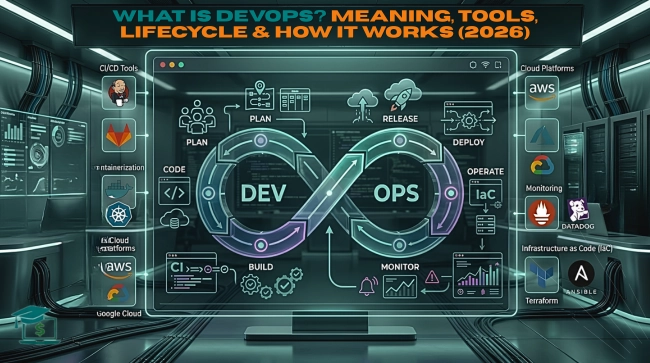
These are the main steps in the DevOps lifecycle:
- Plan: Teams establish the design, the problem to solve, and the need to serve. During this stage, teams can use tools like Jira and Trello to keep track of tasks and priorities.
- Develop: Version Control Systems such as Git are used by developers to write code. They do not commit in large chunks but in frequent ones. This minimizes the chance of major bugs being introduced.
- Build: The code is compiled and converted to a working software program. Tools such as Maven and Gradle do this automatically for you when code is committed.
- Test: Automated Testing Tools execute hundreds or thousands of tests in a couple seconds. Bugs are detected early, before reaching the customers, with tools such as Selenium, JUnit and TestNG. This is an important stage in the software quality assurance.
- Release: If the code is successful after testing, it enters the release stage. This is the task of the CI/CD pipelines (Continuous Integration and Continuous Delivery). Other tools such as Jenkins, GitHub Actions, and CircleCI can automate the entire release process.
- Deploy: The software is deployed to production systems or cloud systems. DevOps teams rely on tools such as Docker and Kubernetes to reliably and scalably manage deployments.
- Operate: The system is maintained by the operations staff. They maintain the performance of their servers, resolve incidents, and manage the infrastructure appropriately for the application.
- Monitor: This is one of the most crucial stages. DevOps monitoring is the real-time tracking of user behavior, system health and application performance. In this area, Prometheus, Grafana, Datadog, and New Relic are among the common tools that are used.
Monitoring is followed by feedback to the planning and the cycle repeats. This is the reason DevOps is termed as continuous loop instead of linear process.
What is a DevOps Engineer?
DevOps engineer is a professional who connects software development with an IT operations. Their job is to design and develop the tools, pipelines, and infrastructure that enable efficient software development and deployment.
In reality, what is DevOps engineering? The role of an engineer often involves tasks such as configuring CI/CD pipelines, managing cloud resources, writing automation scripts, configuring monitoring systems, and ensuring the security of the pipeline at each step.
DevOps engineers make some of the top-paid individuals in tech. The need for rapid and dependable software delivery has become a necessity for businesses in 2026, making this role a hot spot for job opportunities in all sectors.
DevOps automation: What is it?
DevOps automation is an approach that replaces repetitive and manual work with automated scripts and tools. From running tests and porting code to provisioning servers and deploying applications.
Some typical place DevOps automation is used are:
- Testing without having to manually press buttons
- Automation of server setup: Infrastructure as Code (IaC) with tools such as Terraform and Ansible
- Centralized configuration management with a CDN network for all apps and content.- Automated deployments via CI/CD pipelines.
- Continuous monitoring of applications for potential vulnerabilities and failures, and automatic alerting to those issues
The greater a team can automate, the quicker and more reliably they can get software to market. Automation is also effective in minimizing human error, which is one of the primary reasons for production incidents.
DevOps Security: What is it?So What is DevOps Security?
DevOps security or DevSecOps, is the practice of embedding security checks and processes within the DevOps workflow. DevSecOps makes security part of the process instead of an inspection prior to launch.
What is DevOps security and the way it performs in actual teams? Security scans are automatically performed during ‘build’ and ‘test’ phases. If developers’s code is vulnerable, they’ll get immediate feedback. This lets you discover issues early when they would be much easier and cheaper to resolve.
Tools such as Snyk, SonarQube, Aqua Security and HashiCorp Vault are widely used in DevSecOps pipelines.
What Is the DevOps Toolchain?
DevOps toolchain is the set of tools that are adopted by the team throughout the different stages of the DevOps lifecycle. A good tooling chain enables software teams to automate their processes and stay aligned on the software delivery lifecycle.
Let’s take a look at the top tools for 2026:
- This course will cover version control using Git, GitHub, GitLab and Bitbucket.
- The CI/CD Pipelines are Jenkins, GitHub Actions, GitLab CI, and CircleCI.The CI CD Pipelines are Jenkins, GitHub Actions, GitLab CI and CircleCI.
- Containerization: Docker, Podman
- Coding Language: Python
- Infrastructure as Code – Terraform, Ansible, Pulumi
- Monitoring and Observability: Prometheus, Grafana, Datadog, Dynatrace
- Security: Snyk, SonarQube, HashiCorp Vault
- This is also a team collaboration that involves Jira, Slack, Confluence.
There is no one tool that will do it all. The toolchain selection depends on the team size, tech stack and business requirements of the team.
DevOps in the Cloud Computing: What is it?
Cloud Computing is closely linked with DevOps. Teams lean on cloud platforms such as AWS, Microsoft Azure, and Google Cloud for scalability and to deploy and manage applications at scale.
What does this in the cloud specifically refer to? It refers to leveraging cloud-native services to develop automated pipelines, deploy containerized applications, scale systems according to need and monitor systems around the world. They also have their own DevOps services, including AWS CodePipeline, Azure DevOps, and Google Cloud Build.
Cloud-based DevOps enables small teams to function fast and reliably like big teams.
What is DevOps Methodology?
DevOps is a methodology that’s centered on a set of principles that influence the way teams operate. These include:
Working together across silos: Development, operations and security operate as a single unit.
Manual process is automated first: Manual process is eliminated wherever possible.
Continuous improvement – Team’s measure everything and seek constant areas of improvement.
Quick feedback loops: Issues are addressed and solved promptly at each point.
Shared responsibility – everyone is responsible for the quality and reliability of the final product.
It’s this methodology that makes it in different from merely being a set of tools. Tools are important but the culture change is the real key.
Pro Tips for Success
- Take a “baby steps” approach to automation: Don’t expect to automate everything immediately. Find the most painful manual work that your team is doing and automate that one.
- Get observability early: Monitoring and logging are sometimes seen as an add-on. Design them in from the start to identify and resolve issues before they are noticed by users.
- Make infrastructure as code a habit: Handcrafted servers lead to inconsistency and technical debt. It saves a ton of time when using tools such as Terraform from the get-go.
- Develop a no-blame culture: In the event of an incident, identify what went wrong in the system, not who made a mistake. This allows for open and honest communication and quicker learning.
- Preserve CI/CD pipelines’ speed: 30 minutes takes too long, so developers will not use the pipeline. Fine-tune tests and build steps for immediate feedback (minutes not hours).
Common Mistakes to Avoid
- Focusing on DevOps as just a tooling change: No matter how good the tools are, teams operating in silos are still not practicing DevOps. Culture change is the most important factor — not the tools.
- Moving fast without automated testing: Teams that build quickly without testing end up with fragile systems and frequent outages. Always test automatically at every stage.
- Treating security as a last-minute investment: Adding security only at the end of development makes it too late and too expensive. Start scanning from the beginning and run security checks all the way through the pipeline.
- Creating too complex pipeline: Beginners tend to create too advanced pipelines, with too many tools. Begin at a level that is easy and gradually build up difficulty.
- Not bothering to monitor after the deployment: Once a deployment has been successful many teams move on without monitoring. Without proper monitoring, issues can go undetected for hours or even days in production.
Frequently Asked Questions
What is DevOps and why does it matter?
It is an approach that integrates software development and IT operations to develop software quicker and more reliably. It is important because businesses nowadays have to keep updating their software regularly to keep a pace with the developments and DevOps makes it safer and more efficient.
What are the responsibilities of DevOps Engineer?
A DevOps engineer is responsible for developing and improving automation processes, cloud environments, monitoring tools and collaborating with development teams to enhance deployment performance and reliability.
So, what is DevOps monitoring and why is it important?
DevOps monitoring: The process of continuously monitoring the performance of the application, system health, and user behaviour. It enables teams to identify and resolve issues promptly without affecting the users.
Does DevOps Apply to SMBs?
It’s true that practices and tools are available for teams of any size. Many small startups adopt DevOps right away to rival larger companies and get features to market quicker and with greater reliability.
So, what is DevOps and what is the difference from Agile?
Agile is a process that emphasizes small steps and working together to build software. It is a methodology that extends those principles to deployment, operations and monitoring. They do not contradict each other — they complement each other and teams often use them together.
Conclusion
It has revolutionized the process of building, testing and delivering modern software. It’s not a product that you purchase or a tool you install. It’s a paradigm change in the way Dev and Ops teams think, communicate and collaborate.
Once you have read this book, you should have a good head start in pursuing DevOps as a career or introduce it in your organization, as you will have a basic understanding of DevOps, the DevOps lifecycle, tools, and how DevOps engineering fits into it. The DevOps model has a proven track on how to ship better software faster – it can be a great path for any developer who wants to grow their skills, an IT professional who wants to learn about DevOps engineering, or a business leader who wants to do it.
In 2026, the winning teams are not necessarily the ones with the largest number of developers. They have the quickest and most dependable delivery pipelines. DevOps is how they built them.